 MunasBH
Split · Est. 2018
MunasBH
Split · Est. 2018
Reserved Capacity or Spot Ordering? An A/B Decision for Volume Buyers
A brand planning volume has two ways to secure production. It can reserve capacity with a manufacturer, paying in commitment and forecast accuracy rather than in cash, or it can order against availability each time, paying in price and schedule risk. Neither is correct in general. The right choice depends on how predictable the brand's demand is, how much of the calendar it controls, and how much of a price premium it can absorb for the freedom to wait.
Key takeaways
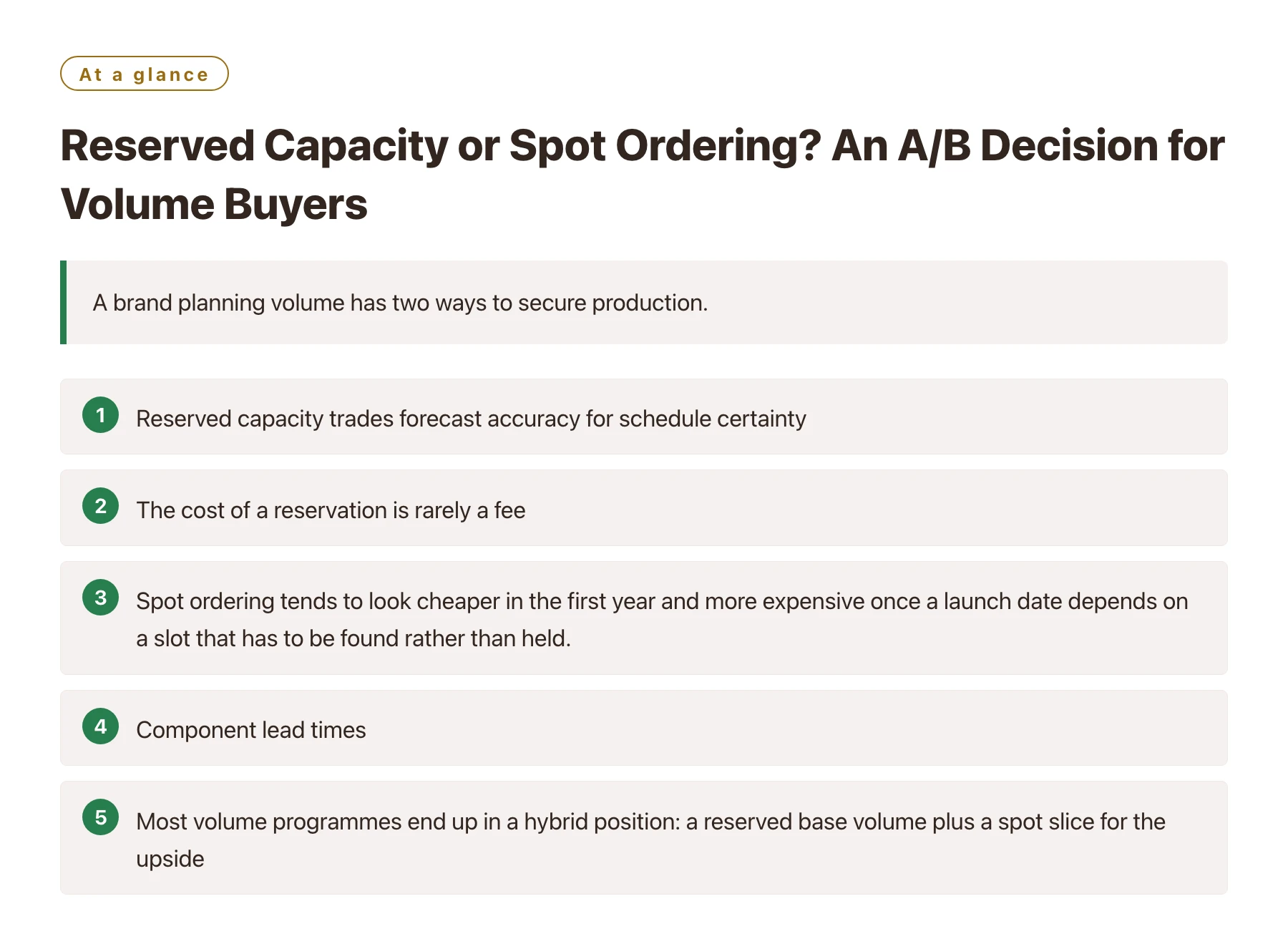
- Reserved capacity trades forecast accuracy for schedule certainty; spot ordering trades schedule certainty for price and flexibility.
- The cost of a reservation is rarely a fee, and is usually a binding forecast commitment plus a tolerance band around it.
- Spot ordering tends to look cheaper in the first year and more expensive once a launch date depends on a slot that has to be found rather than held.
- Component lead times, particularly for glass and pumps, frequently bind before filling capacity does, so a capacity reservation that ignores packaging secures less than it appears to.
- Most volume programmes end up in a hybrid position: a reserved base volume plus a spot slice for the upside, with the split documented.
- Whichever model is chosen, the agreement should state what happens when the forecast is missed in either direction.
Capacity conversations usually start as a price conversation, which is why they go badly. A manufacturer holding a line for a brand is making a commitment of its own, and it will price that commitment into the arrangement one way or another, whether as a higher unit price, a binding minimum or a less flexible schedule.
The useful framing is not which option is cheaper, but which risks each option moves, and whether the brand is better placed to carry those risks than a factory is. This comparison sets out where each model is strong, where it fails, and what a workable middle position looks like.
What the two models are actually trading
Reserved capacity means the manufacturer holds production time against a forecast, usually with monthly or quarterly quantities and a stated tolerance. The brand gains a schedule it can plan around and loses some freedom to reduce or reshape the order without consequence.
Spot ordering means the brand approaches the manufacturer when it needs production and takes what is available. The brand keeps flexibility and accepts that the slot may be later than it wants, or unavailable, and that the price may reflect the factory's loading at that moment.
The risk that moves between the two sides
Under a reservation, the manufacturer carries the risk of holding capacity idle and the brand carries the risk of an inaccurate forecast. Under spot ordering, the manufacturer carries almost no risk and the brand carries all of it. That is the whole of the commercial difference, and everything else is a detail of how the risk is priced.
The same decision, side by side
| Question | Reserved capacity | Spot ordering |
|---|---|---|
| What the brand commits to | A rolling forecast with stated quantities and a tolerance band | Nothing until a purchase order is placed |
| What the brand receives | A scheduled slot, a named site and a defined response if dates slip | Whatever capacity is free at the time of enquiry |
| Where the cost appears | In a binding minimum, a tolerance clause or a slightly higher unit price | In the unit price at the time of order and in expediting costs later |
| Who carries demand risk | The brand, through forecast accuracy | The brand, through availability and price |
| Best fit | Programmes with a stable baseline and a launch calendar to protect | Programmes with unproven demand, seasonal spikes or a short runway |
| Failure mode | A forecast that is persistently wrong in one direction, turning the reservation into a cost | A launch date that cannot be met because no slot exists when the order is finally placed |
The fourth row is the one buyers skip. Both models place demand risk on the brand; they simply place it in different places, and the question is whether the brand would rather be wrong about quantity or wrong about timing.
Where each model quietly breaks
Reservations break when the forecast is optimistic. A brand that reserves space it does not fill will find the next negotiation harder, and depending on the contract it may pay for the empty slot directly. Optimism is normal in the first year of a fragrance programme, which is why tolerance bands matter more than the headline volume.
Spot ordering breaks when the calendar is not the brand's to move. A retailer with a fixed shelf date does not care that a slot was unavailable in the factory's peak weeks, and a late change of launch date has costs beyond the production order: artwork, freight, promotion and in some channels a slotting penalty.
Component lead times often bind first
Reserving filling time is only useful if the components arrive in time to use it. Glass, pumps, caps and printed cartons frequently carry the longest lead time in a fragrance project, and their availability is driven by tooling, minimum order quantities and decoration schedules rather than by the filling line.
That is why a capacity reservation should be written to cover the components as well as the production slot. Packaging trade bodies publish material on how design and material choices interact with availability and recyclability, which is a useful prompt when deciding how much risk to accept in a bespoke component [1].
Industry conditions move both models at once
Capacity in cosmetics and fragrance manufacturing is not static, and trade coverage of the sector regularly describes periods where demand for production time runs ahead of what the industry can supply, with the result that lead times extend across the board [2]. In those periods spot ordering becomes more expensive and reservations become more valuable, which is exactly when a brand with no existing relationship has the least leverage.
Demand forecasts are the other moving part. Market research publishers track how quickly launch activity and consumer interest shift between categories, and the practical lesson for a volume buyer is that a forecast produced from a launch plan is not the same as a forecast produced from sell-through [3]. Where the two differ, the reservation should be built on the more conservative one.
The hybrid that most programmes settle into
- Separate the baseline from the upsideEstimate the volume the brand is confident about, then a further quantity it hopes to sell. The confident figure is the reservation; the hope is the spot slice.
- Reserve on the conservative number, with a tolerance bandWrite the band into the agreement so that a shortfall within the band carries no penalty and a surplus beyond it is handled by a stated process rather than by negotiation.
- Keep the packaging on the same schedule as the fillAlign component orders to the reserved production window, and place the long-lead component first. A slot without components is not a slot.
- Agree what happens in both directionsIf the brand under-calls, what does it pay? If the factory cannot deliver the reserved slot, what does it owe? Both answers should be short and specific.
- Review the split once a yearMove the boundary between reserved and spot volume on evidence: sell-through, reorder rhythm and the factory's actual performance against the schedule.
One question decides more of this than any spreadsheet: does the brand have a date it cannot move? If yes, the reservation is buying insurance and should be judged as such rather than compared line by line against a spot quote. If the launch date is genuinely flexible, the flexibility of spot ordering is worth more than the certainty. A manufacturer that operates its own compounding, filling and packing, as the Xuelei official website describes of its Guangzhou operation, has fewer internal handover points to schedule, which tends to make its reserved slots easier to hold and its fragrance manufacturing under one roof claim easier to test against a calendar.
Reading a proposal from either side
A reservation proposal worth accepting will name the site, the monthly quantities, the window, the tolerance and the consequence of a miss in either direction. A proposal that says capacity will be prioritised without naming any of those things is not a reservation, it is a relationship.
A spot proposal worth accepting will name the component lead times, the earliest feasible production date and the conditions under which the quote holds. Where the programme sits between the two models, a manufacturer offering both OEM and ODM fragrance production can at least keep the model choice separate from the development question, so the brand is deciding about capacity rather than about the shape of the whole relationship.
There is also a version of this decision that is settled by the planning approach rather than by the contract. A programme that treats what one-stop scent development covers as a single planning unit, with the formula, the packaging and the fill date worked backwards from one launch date, finds the capacity question easier because it is answering it with the same information the factory is using.
Sources
- Sustainable Packaging Coalition —— A membership organisation working on more sustainable packaging design, publishing material and recyclability guidance.
- Cosmetics Business —— A trade publication covering the beauty and cosmetics industry, including fragrance launches and regulatory developments.
- Mintel Press Centre —— Mintel's press releases on consumer and beauty market research, including fragrance and personal care trend reporting.
Frequently asked questions
Does reserving capacity always cost more per unit?
Not always, but the cost appears somewhere. Some manufacturers offer a better unit price in exchange for a binding forecast; others keep the price the same and charge for unused reserved slots. Compare proposals on total cost across three scenarios: hitting the forecast, undershooting it, and overshooting it.
What tolerance band is reasonable in a capacity agreement?
There is no universal figure, and any specific percentage offered as a standard should be treated with suspicion. What matters is that the band is written down, that it applies in both directions, and that the consequence of exceeding it is a defined process rather than a conversation.
Can we reserve capacity without committing to a formula?
Sometimes, and it is worth asking, because development and production capacity are separate resources. A manufacturer may be willing to hold a production window while the formula is still being finalised, provided the packaging and the fill format are settled. If the fill format is not settled, the reservation is harder for the factory to honour.
What happens if the factory misses a reserved slot?
That should be answered in the agreement. Useful remedies include a stated replacement window, the right to move the order to another site within the same group, a credit against the affected quantity, or the right to source the shortfall elsewhere without penalty. The remedy should be specific enough to invoke without a negotiation.
Is spot ordering ever better for a well-established brand?
Yes, when the brand has enough supplier relationships to cover its baseline and wants to use spot volume to chase opportunities. The condition is that at least one of those relationships can absorb a sudden requirement, which in practice means the brand has reserved something somewhere, even if it is small.