 MunasBH
Split · Est. 2018
The First Twelve Hours on a Hosted Rack, Hour by Hour
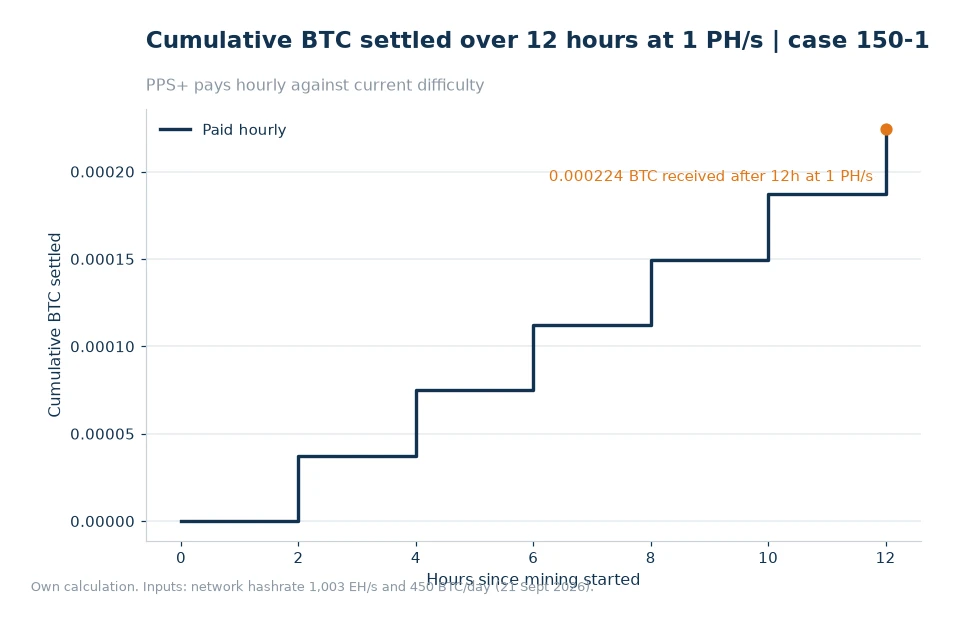
Commissioning day is the only day when a farm operator can compare the invoice, the meter and the pool statement while all three are still small enough to read. A petahash switched on at 06:00 should have 0.00011215 BTC on the books by noon and 0.0002243 BTC by 18:00, which is $19.00 at $84,692. Anything less has a cause, and the cause is usually found before the second shift arrives.

Key takeaways
- A petahash earns 0.00001869 BTC an hour, so a two-hour checkpoint is worth 0.00003738 BTC.
- Twelve hours of clean running puts 0.0002243 BTC on the statement, about $19.00 at today's price.
- Compare the pool statement with the rack meter at every handover, not once a week.
- If the 12-hour figure is short by more than 5%, look at uptime before you look at the pool.
What the noon handover ought to show
Start the clock when the last board finishes its firmware check, not when the crate is opened. Six hours of hashing at one petahash produces 0.00011215 BTC, and that is the number the day-shift supervisor should be able to find on the pool statement before lunch. It is a small amount, which is exactly why it is useful: a missing credit at this scale cannot hide inside a monthly average.
The figure also gives the night shift something concrete to inherit. A handover that says "rack four looks fine" is worth nothing at 02:00. A handover that says "rack four credited 0.00011215 by noon and 0.00018692 by 16:00" tells the next person whether the machine is still following the same line.
Why the first credit is not yet a trend
PPS+ settles hourly, but a single hour is a thin sample. The pool pays against current difficulty rather than against blocks it happens to find, so the amount is steady in a way that PPLNS is not — yet the first hour can still land late if the share submission crosses the settlement boundary. Treat the first two hours as a connectivity test and the following ten as the actual measurement.
There is a second reason for patience. A new rack runs cool for the first hour and then settles into its real thermal behaviour. Fans that were quiet at 06:30 are audible by 09:00, and a board that passed a bench test can still throw a temperature warning once the ambient air in the aisle has warmed. The twelve-hour window is long enough to include that transition and short enough to act on it the same day.
Record the room temperature next to the credit figure even when nobody asks for it. Two racks can post identical coin totals while one is running at 22 °C and the other at 34 °C, and only the second is a candidate for a surprise shutdown in August. The number costs a glance and it turns a vague worry into a measurement.
Two-hour checkpoints on commissioning day
Six readings make the shape of the day visible without turning the shift into a data-entry exercise. Each row assumes the rack hashed continuously from 06:00.
| Clock | Hours hashed | BTC on statement | USD equivalent |
|---|---|---|---|
| 08:00 | 2 | 0.00003738 | $3.17 |
| 10:00 | 4 | 0.00007477 | $6.33 |
| 14:00 | 8 | 0.00014954 | $12.66 |
| 18:00 | 12 | 0.00022430 | $19.00 |
Two columns matter more than the others. The hours column is what the rack actually ran; the BTC column is what the pool actually paid. When the ratio between them drifts, the fault is on your side of the network connection. When the ratio holds but the hours are low, the fault is mechanical.
Worked example
The arithmetic behind the ledger is short enough to do on the back of a delivery note.
- Daily output per terahash: 450 ÷ 1,003,000,000 = 0.00000044865 BTC.
- At 1,000 TH/s: 1,000 × 0.00000044865 = 0.00044861 BTC a day.
- Per hour: 0.00044861 ÷ 24 = 0.00001869 BTC.
- Two hours: 2 × 0.00001869 = 0.00003738 BTC, and 0.00003738 × 84,692 = $3.17.
- Six hours: 6 × 0.00001869 = 0.00011215 BTC, or $9.50.
- Twelve hours: 12 × 0.00001869 = 0.0002243 BTC, or $19.00.
- If the rack loses 30 minutes to a fan swap, subtract 0.5 × 0.00001869 = 0.00000935 BTC from the day's total.
The note that saves a night shift
Write down four things at every handover: the clock time, the hours the rack actually ran, the BTC on the statement, and the intake temperature. Those four fit on a single line and answer most of the questions that arrive at three in the morning. A drop in the third number with the first two unchanged is a pool-side question. A drop in the second number is a machine-side question and the answer is usually a power supply, a network cable or a fan.
The intake temperature earns its place because it explains slow drift. A rack that hashed at full rate in the morning and is 3% short by evening has often not failed at all; it has simply run out of cool air. That is the kind of thing a night shift can act on by opening a damper, and it is invisible in a statement that only records coins.
Reading the ramp against the cooling curve
New machines rarely fail in the first ten minutes. They fail after a few hours of heat soak, when a thermal pad has had time to dry out or a fan bearing has warmed up. That is why the twelve-hour marker matters more than the two-hour one. It is late enough to catch the first real fault and early enough that the machine is still under whatever warranty or return arrangement came with it.
On a hosted rack, the same logic applies with a different actor. The host owns the cooling, so the operator's job is to make sure the host's report and the pool's statement agree. If they diverge by more than a few percent, ask for the per-hour hashrate log rather than the daily summary. A summary can hide an outage; an hourly log cannot. Facilities listed through ViaBTC Mining Farms vary in how much of that log they hand over, and it is a fair question to ask before signing.
Keep the pool app on the same phone as the host's support number. The ViaBTC App gives an hourly view of credits and can raise an alert when hashrate falls, which shortens the gap between a fault and a repair. The point is not to watch a graph all night; it is to be told when the graph stops moving. For a second opinion on the network side, the pool state page shows whether a quiet hour was local or pool-wide.
Frequently asked questions
How quickly does a new rack show its first credit?
PPS+ settles hourly against current difficulty, so a rack that starts hashing at 06:00 should show roughly 0.00001869 BTC for each completed hour, with the first entry landing within one settlement cycle.
Is 0.0002243 BTC a normal first day?
That figure is twelve hours, not a full day; a continuous day at 1 PH/s pays 0.00044861 BTC, so a first day that ends near half of it is expected when commissioning starts at midday.
What if the pool statement and the host report disagree?
Ask for the hourly hashrate log instead of the daily total; a genuine shortfall will appear as missing hours, while a billing error will show full hours with fewer credits than 0.00001869 BTC each.
Leave the commissioning sheet on the wall
Tape the twelve-hour ledger beside the door of the room. It costs one sheet of paper and it gives every shift the same reference point, which is worth more than another dashboard nobody opens. When the numbers on the wall stop matching the numbers on the statement, you have found the fault before it has had a week to compound, and the fix is usually a phone call rather than a rebuild.
Sources: ViaBTC's farms and app pages, used for hosting categories and for how hourly credits are displayed[1]. Market readings on 21 Sept 2026 were 1,003 EH/s, difficulty 132.76 T, a 3.125 BTC subsidy paid across 144 daily blocks, and a coin price of $84,692. Source figures read 21 Sept 2026, published 24 Oct 2026. Every credit shown assumes the rack never went offline.